Quantum Electrodynamics, Scholasticism, and The Spanish Knight of La Mancha
Collection: Nov 30th-Dec. 3rd, 2025

QED: The Strange Theory of Light and Matter
Essays/Lectures by Richard P. Feynman, 1985
One day I’ll understand quantum mechanics, but not this week. I’ll try again next time.
QED is a series of lectures attempting to simplify the principles of “quantum electrodynamics.” In other words: a look into how different phenomena of light and matter, such as the iridescence of oil slicks or partial reflections of light-on-glass, can be explained via quantum mechanics.
Throughout the book, Feynman admits this topic is impossible to simplify and apologizes for it being so difficult. Ironic, considering the most infamous quote of Feynman’s amounts to “if you can’t explain it to a five year old, you don’t understand it.” Nothing in this book can be explained to five year olds.
Like Gödel, Escher, Bach, QED has a pop appeal but is by no means a basic introduction to anything. I had fun nonetheless. For the graph/diagram lover, there are lots of disorienting graphs and diagrams. I did leave with a feeling I glimpsed a piece of the broader picture.
Gothic Architecture and Scholasticism
Lecture/Essay by Erwin Panofsky, 1957
I understand scholasticism and gothic architecture about as much as I understand quantum mechanics. And still I try.
This book is quite short. There’s a lot of cathedral terminology, which is fun and poetic to the uninitiated. Lots of “naves” and “tricepts” and “colonettes” and comments about ignorant Milanese architects. Plenty of wonderful printed photos of High Gothic cathedrals as well.
What I found most interesting, though, was Panofsky’s explanation of scholasticism as a philosophy that developed prior to any schism between mysticism and rationalism. Not faith or reason, but faith through reason.
This observation may explain why Scholastic writers like Thomas Aquinas believed issues of faith could be logically deduced. It may also explain why Gothic cathedrals are full of these logical subdivisions, parts of three breaking into further parts of three breaking into further parts of three.
I’m not sure how sound it is, but it made me look at cathedrals and The Divine Comedy (which Panofsky claims is an essential text of Scholasticism) completely differently.
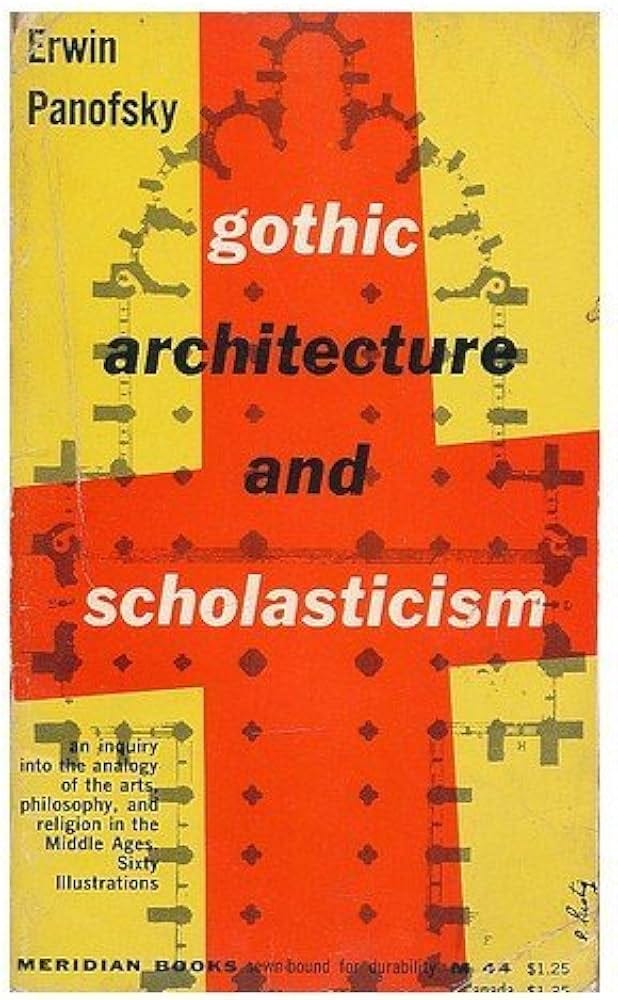
Don Quixote
Cervantes, 1605-1615
There is so much to say about this book. Plenty has already been said. It’s awesome, ok? Just deal with it. My favorite parts are when people around Don Quixote get so exhausted by his mania, they just humor him for a bit.
Maybe I’ll say more in due time.